Author: ES Aquatic Science

  • Dispatches from quarantine. Field work and COVID-19 in Alaska

    This post is based on publicly-available news articles about COVID-19 in Alaska and my own subjective experience and is in compliance with NOAA Administrative Order 216-100 (NAO 216-100)

    It is 9:41 PM and I am completing a mandatory quarantine in a hotel room in Anchorage, Alaska. I have not left this room. Meals are brought to me and left outside the door, and aside from a few minutes of innocuous chit-chat during my twice-daily temperature checks, slivers of eye contact behind masks and plexiglass, I have not seen another human being. I am alone.

    I am alone, but I’m not lonely. Thankfully the internet has given me a way to stay connected to the outside world, and I have a window overlooking the dirty snow of the hotel parking lot. This feeling is, and isn’t, new. I am preparing to deploy (that’s the word we use) for 60-90 days. Every time I deploy my world becomes a little bigger, but also a little smaller, in equally dramatic ways.

    In case anyone among the processors, engineers, deckhands, cooks, or biologists in this hotel forgets how important this quarantine is, dedicated staff patrol the hallways on the lookout for breaches. I don’t need them to remind me; During the daily morning doomscroll I came across a recent dispatch from a local news outlet in Dutch Harbor, the largest commercial fishing port in the U.S. There has been another case. The port has elevated its threat level, the town is hunkered down, and the plants are locking down.

    These are extreme measures, but Alaska is an extreme place. I am amazed at the human ability to deny vulnerability, to keep looking forward. The crowded conditions aboard fishing vessels and at shore-side processing plants nearly guarantee that if a single COVID-19 carrier slips through, like water through a cracked hull, the vessel will succumb. The risk to nearby communities is also acute. Small local clinics (you can count the medical staff on one hand) can quickly become overwhelmed. Charter planes, helicopters, and boats are needed to carry the sick to the nearest hospital. This part of the world was once called “the Kingdom of the Winds”. Trees don’t grow here. They are blown over, knocked down, covered by snow, boughs and branches frozen and shattered by ice that builds in layers with every gust. At the end of the day, we haven’t out-engineered low pressure systems.

    I am amazed at the human ability to deny vulnerability, to keep looking forward. I hear good news. There is a vaccine. The vaccine is coming by plane, by boat, by helicopter, by sled. Until then, I’ve got candy crush and the dirty snow of a hotel parking lot.

    ————————-

    I hope you enjoyed this blog post. If you would like to learn more about the impact of COVID-19 on Alaska’s fishing industry and the COVID-19 vaccine rollout, please check out the following articles:

    https://www.adn.com/business-economy/2020/09/01/alaska-fishing-industry-likely-incurred-tens-of-millions-of-dollars-in-coronavirus-related-expenses/

    https://www.alaskapublic.org/2020/07/22/alaska-fishing-communities-feared-covid-19-contagion-from-industry-it-hasnt-shown-up/

    https://www.npr.org/2021/01/11/954881785/we-dont-feel-forgotten-at-all-alaska-fires-up-covid-19-vaccine-rollout

  • The Three Seahorses of Biscayne National Part 2: A park under pressure

    By Emilie Stump

    In part two of this three-part series, marine ecologist Emilie Stump reports on threats impacting seahorse habitats and populations in Biscayne National Park, focusing on land use, water quality and the commercial bait shrimp fishery.

    In my search for seahorses and pipefishes I extensively surveyed the marine habitats of Biscayne National Park (BNP) to learn more about these cryptic animals. BNP is a living, breathing emerald and aquamarine jewel in the U.S. National Park System. Located in southeastern Florida, just south of “Magic City” (Miami, Florida), the park protects a 728km2 gradient of vulnerable coastal habitats including mangroves, seagrasses, and coral reefs. I also attended meetings held as part of NOAA’s Biscayne Bay Habitat Focus Area Initiative with representatives from federal, state, and local government, non-governmental organizations, academia, and representatives of the fishing industry to learn more about the history of the park and current environmental challenges. These meetings and my on-the-ground experience revealed a park that is under pressure from a variety of threats.

    How has land use and development affected Biscayne National Park?
    BNP protects a little bit of nature in a landscape otherwise heavily altered by humans. It is bordered to the north and the west by Miami-Dade County, a growing urban community that is home to nearly 2.8 million people. Increased development of the region has led to the introduction of nutrients (like nitrogen or phosphorus), chemical pollutants, suspended sediment, and heavy metals from sources such as landfills, port dredging projects, agricultural or urban storm water run-off, and over-flowing septic tanks. Instead of being filtered through wetlands and mangrove forests, freshwater laced with contaminants is channeled into a system of man-made canals that deliver concentrated freshwater discharges laced with a cocktail of nutrients and contaminants in large pulses to Biscayne Bay. I especially noticed effects of these discharges along the western boundary of the park, near the mouths of the canals.

    Decreased water quality has led to an increase in documented algae blooms in semi-enclosed, shallow water Biscayne Bay. These blooms block sunlight from reaching seagrass blades, leading to seagrass die-offs.  Less seagrass could mean less available habitat for seahorses and other species that depend on them. Research from state and federal level management and monitoring agencies suggests that the frequency of algae blooms in the Bay is increasing, and that the Bay is in danger of reaching a “tipping point”, shifting from a seagrass-dominated system (photo on the left) to a system with substantially less seagrass regularly experiencing algae blooms in the water column and on the substrate (photo on the right).

    Left: Healthy bed of Turtle Grass (Thalassia testudinum) in Biscayne Bay. Right: Mixed seagrass covered with cyanobacteria in Biscayne Bay. Cyanobacteria blooms feed on excessive nutrients introduced to the Bay from freshwater discharges.

    Commercial bait shrimp trawling in Biscayne Bay
    It surprised me to learn that the Biscayne Bay portion of BNP is subject to commercial fishing, including trawling for bait shrimp. Bait shrimp are harvested using a type of gear specific to Florida called the roller-frame trawl. According to a 1997 report by University of Miami researchers, roller-frame trawls causes minimal damage to seagrass beds but can cause substantial damage to potential seahorse holdfasts including corals, sponges, gorgonians and other organisms found in the hardbottom habitats of Biscayne Bay.

    This lined seahorse ( H. erectus ) is using a mermaid’s fan ( Udotea  sp.) colonized by soft corals and sponges as a holdfast.
    This lined seahorse (H. erectus) is using a mermaid’s fan (Udotea sp.) colonized by soft corals and sponges as a holdfast.

    A fisheries-independent survey published by Dr. Joe Serafy and colleagues in 1997 revealed that roller-frame trawls are also known to catch at least eight species of seahorse or pipefish in BNP as bycatch. Additional research published by Dr. Julia Baum showed that large seahorses, such as the lined and long-snouted seahorses of BNP, may be the most vulnerable. This study estimated that 72,000 lined seahorses per year were caught as bycatch by 31 trawlers operating off Hernando Beach, Florida Possible effects on populations include direct mortality to seahorses and their relatives or disrupting social structure.

    Dr. Baum, whose research took place in the Gulf of Mexico, documented that once these large seahorses were taken in as bycatch they were sometimes transferred to either the marine aquarium trade or the curio trade, to be dried and sold as souvenirs. During my time in south Florida I spoke with collectors for the marine aquarium trade who confirmed that they had received buckets of seahorses that were originally collected as bycatch from the bait shrimp fishery in Biscayne Bay. While collection of animals for the aquarium trade is regulated in Florida, animals entering the trade as bycatch may not be accounted for when setting yearly or seasonal catch quotas and are not likely to be reported in official catch statistics.

    What does this mean for seahorses and their relatives in BNP?
    Seahorses and their relatives are dependent on healthy habitats. Despite their protected status, habitats within BNP are exposed to a myriad of threats. Two potential threats are habitat degradation due to land-use practices, and habitat damage caused by bait shrimp trawling using roller-frame trawl gear. In addition to causing habitat damage, bait shrimp trawling disrupts populations and may illegally remove animals from Biscayne National Park for the curio and/or aquarium trades.

     Part three will focus on conservation solutions by highlighting habitat-centered initiatives in the 2014 Biscayne National Park Fisheries Management Plan, and how implementing these measures will benefit seahorses and their habitats.

  • The Three Seahorses of Biscayne National Park, Part 1

    The Three Seahorses of Biscayne National Park, Part 1

    By Emilie Stump

    Part one of a three part series: in this first part Ecologist and marine life artist Emilie Stump commemorates a national treasure with her latest multimedia piece, “The Three Seahorses of Biscayne National Park”

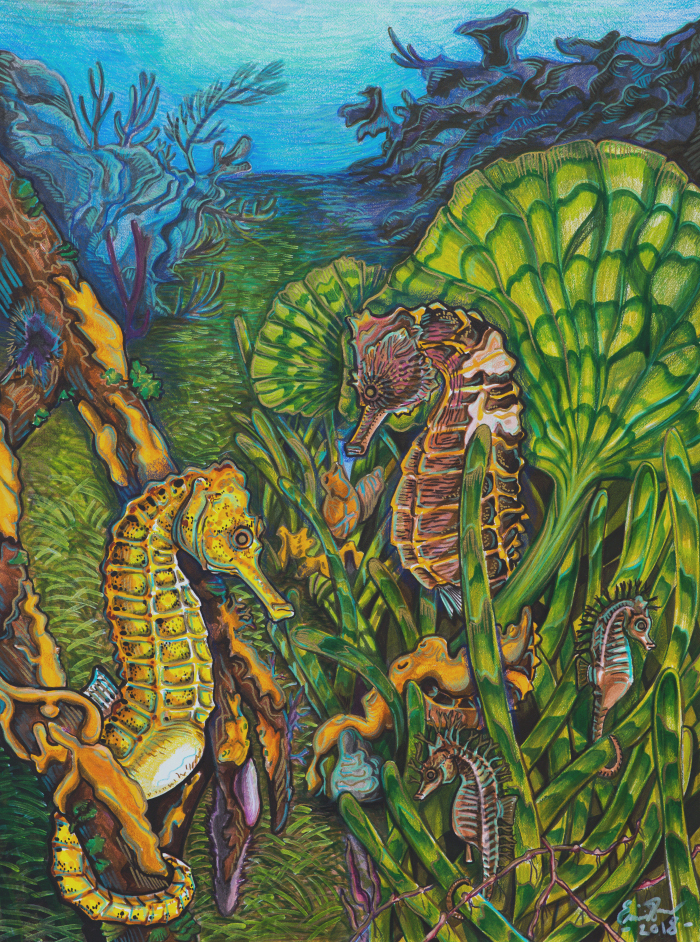
     The three seahorses of Biscayne National Park: The Long-snouted seahorse ( H. reidi,  front left) clutches a submerged mangrove using camouflage to blend into the sponges and other organisms that colonize the roots. The Dwarf seahorse ( H. zosterae , middle right) in a bed of turtle grass, using drift algae as a holdfast. The Lined seahorse ( H. erectus,  back center), holding mermaid’s fan, a type of macroalgae. Coral reefs, which also serve as important habitat for seahorses and their relatives, appear in the background. Artwork by Emilie Stump. This artwork was created referencing the photography of George Grall and Tami Weiss.
    The three seahorses of Biscayne National Park: The Long-snouted seahorse (H. reidi, front left) clutches a submerged mangrove using camouflage to blend into the sponges and other organisms that colonize the roots. The Dwarf seahorse (H. zosterae, middle right) in a bed of turtle grass, using drift algae as a holdfast. The Lined seahorse (H. erectus, back center), holding mermaid’s fan, a type of macroalgae. Coral reefs, which also serve as important habitat for seahorses and their relatives, appear in the background. Artwork by Emilie Stump. This artwork was created referencing the photography of George Grall and Tami Weiss.

    Vulnerable coastal habitats such as seagrasses, coral reefs, and mangroves are important for many animals, including species listed as threatened at the state, national, or international level. Among these species of conservation concern are three seahorses, which I feature in this multimedia illustration. “The three seahorses of Biscayne National Park” showcases south Florida’s seahorses and their habitats. With this artwork, I hope to bring awareness to the importance of protected areas like Biscayne National Park in preserving habitat for vulnerable species, while highlighting the challenges of managing a protected area under pressure.

    On the left of the panel, the Long-snouted seahorse (Hippocampus reidi), recognized by its long snout and relatively low coronet, is using the submerged prop root of a red mangrove as a holdfast. Long-snouted seahorses are found in coastal waters of the western Atlantic from North Carolina south along the coast of the U.S., throughout the Gulf of Mexico and Caribbean Sea, and along South America to southern Brazil. This species is found in a variety of habitats including sponges, tunicates, gorgonians, seagrasses, macroalgae, estuaries, and is often found in mangroves. Like all seahorses, the Long-snouted seahorse uses camouflage to better hunt for prey, and to hide from predators. Submerged mangrove roots are often colonized by invertebrates such as brightly colored sponges and tunicates, and, like a chameleon, this seahorse has changed its coloration to match its surroundings. This species of seahorse is highly sought after in the aquarium trade due to its often-bright coloration. The Long-snouted seahorse reaches a maximum height of 17.5 cm and is listed as Near Threatened on the IUCN Red List.

    In the lower right of the panel, the tiny Dwarf seahorse (Hippocampus zosterae) clutches drift algae and a blade of grass in a bed of turtle grass (Thalassia testudinum). Florida is the center of the global distribution of this tiny species, representing 46% of its global range. These tiny seahorses reach a maximum height of only 2.5 cm and may rely on rafts of floating algae and vegetation to drift to new areas. The Dwarf seahorse has been described as a generalist in the seagrass landscape. The Dwarf seahorse was recently assessed as Least Concern on the IUCN Red List, largely in response to increases in regulation of the Marine Life Trade, which supplies seahorses and other marine organisms for public and private aquariums. These regulations include reducing the daily commercial limit from 400 to 200 seahorses, establishing an allowable harvest area, and establishing an annual commercial quota. These regulations partially resulted from the 2012 proposed listing of the Dwarf seahorse on the US Endangered Species Act.

     Biscayne National Park (BNP) in southeastern Florida
    Biscayne National Park (BNP) in southeastern Florida

    Finally, the Lined seahorse (Hippocampus erectus), recognized by the lined pattern on the side of its face, is largest of the three species (19 cm maximum height). This is the most widely distributed of south Florida’s seahorses, being found in the western Atlantic from Nova Scotia south to Brazil, including the Gulf of Mexico and Caribbean Sea, to depths of at least 100 m. This species is also found in a wide variety of habitats including mangroves, seagrasses, macroalgae, floating vegetation, oyster reefs, rocky reefs, and coral reefs. The Lined seahorse is listed as Vulnerable on the IUCN Red List. Research has shown that Lined seahorses are frequently taken as bycatch in commercial trawl fisheries targeting shrimp in Mexico, Florida, and throughout the Gulf of Mexico.

    The primary global threats to seahorses around the world include being caught as bycatch in trawl fisheries, loss of habitat, and collection for the aquarium, curio, and medicinal trades. Marine protected areas such as Biscayne National Park (BNP) are one of many tools that can be used for the conservation of seahorses and other endangered animals.

    Biscayne National Park is a living, breathing emerald and aquamarine jewel in the U.S. National Park System. Located in southeastern Florida, just south of “Magic City” (Miami, Florida), the park protects a 728km2 gradient of vulnerable coastal habitats. The park’s western park boundary protects the longest remaining stretch of continuous red mangrove forest left on the east coast of Florida. To the east, Biscayne Bay is a shallow, clear water lagoon with hardbottom habitat, home to sponges, gorgonians and corals, or seagrass meadows releasing pearls of oxygen into the water. Across the Bay lie the northern-most extent of the Florida Keys barrier island system, colorful and complex patch reefs, and the crest of this portion of the Florida reef tract, followed by a sudden drop to the depths of the Atlantic. The 65 ft (approximately 20 m) depth contour forms the eastern boundary.

     Totten Key, one of the uninhabited northern-most Florida Keys found in Biscayne National Park. Mangrove coastlines and seagrass beds seen in this aerial photograph provide potential habitat for seahorses and pipefishes. Photograph ©US National Parks Service
    Totten Key, one of the uninhabited northern-most Florida Keys found in Biscayne National Park. Mangrove coastlines and seagrass beds seen in this aerial photograph provide potential habitat for seahorses and pipefishes. Photograph ©US National Parks Service

    In addition to providing valuable seahorse habitat seagrasses, mangroves, and coral reefs are vital to south Florida’s growing economy. Coral reefs protect the shoreline and inshore areas by reducing wave and storm energy. Mangroves provide protection from erosion and are an important source of food and shelter for commercially and recreationally important fishes. Both mangroves and seagrasses absorb nutrients in the water and trap organic material and sediment, helping to maintain pristine, crystal clear waters. Mangroves, seagrasses and coral reefs also provide important habitat for commercially and recreationally important fishes and invertebrates. Residents and visitors to south Florida are spending increasing amounts of time enjoying the outdoors with activities such as recreational fishing, snorkeling, paddle boarding, and scuba diving.

    The first in this three-part series introduced the reader to three magical creatures: The Long-snouted seahorse, the Dwarf seahorse, and the Lined seahorse. These animals rely on important coastal habitats such as mangroves, seagrasses, and coral reefs, all of which can be found in Biscayne National Park’s undersea landscape. Part 2 will explore Biscayne National Park as a vulnerable park, subject to an onslaught of internal and external pressures, and showing signs stress.